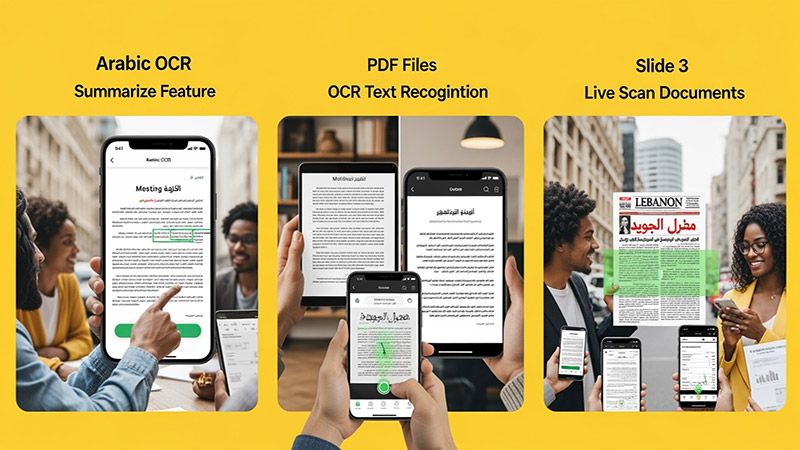
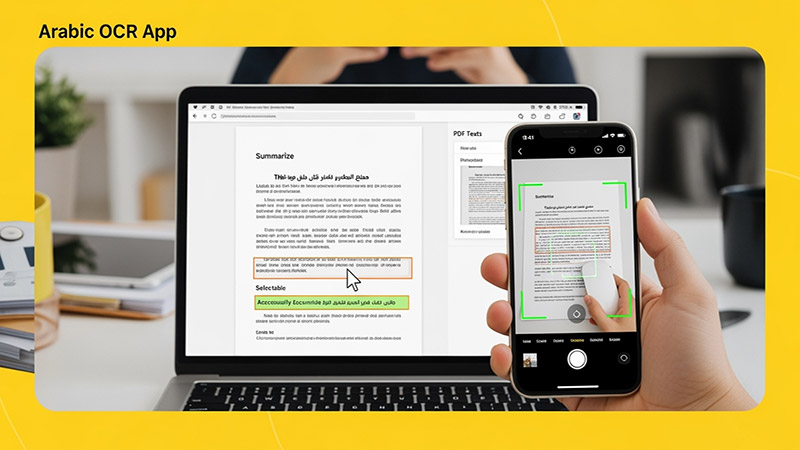
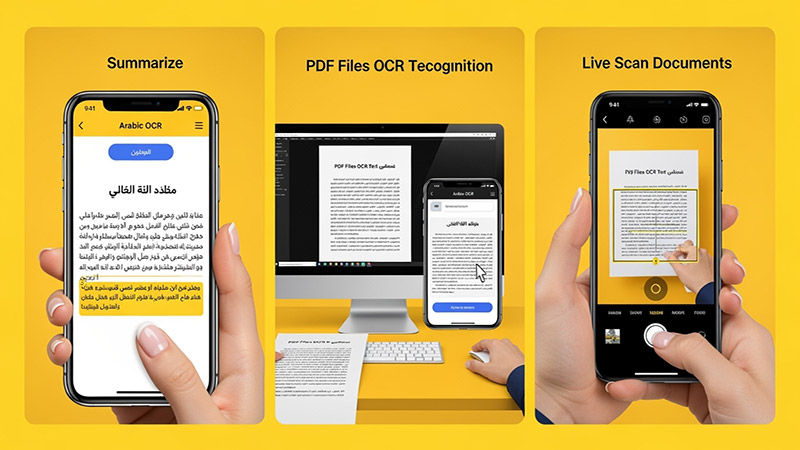
Scan documents, handwriting, or images and convert them into editable Arabic text using advanced AI. Try the free online demo below or download the app for full access on iOS, Android, and macOS.
يتعرف بدقة على النص العربي المطبوع والكتابة اليدوية من الصور أو ملفات PDF أو المستندات الورقية.
Upload an image, try your handwriting, or drop a file here to extract Arabic
text instantly.
(For full results & PDF support, download the app
below)
Click or Drag Image Here
Supports JPG, PNG - Try Handwriting!
(For PDF Files, please download the App)
Processing... / جاري المعالجة
Want full text & PDF support? / هل تريد النص الكامل ودعم PDF؟
Use advanced Arabic OCR to scan images, PDFs, and handwriting with high precision.
Perfect for students, professionals, journalists, and researchers.
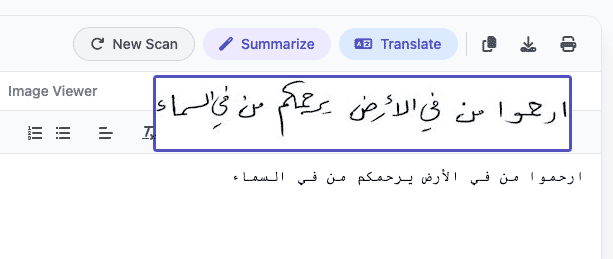
Experience unmatched precision in detecting and extracting Arabic handwriting. Our advanced AI models are trained to recognize various styles of scripts, from student notes to historical manuscripts, converting them into digital text instantly.
اكتشف قوة الذكاء الاصطناعي في التعرف على الخط العربي اليدوي واستخراجه بدقة مذهلة. تم تدريب نماذجنا المتقدمة لمعالجة مختلف أنماط الكتابة، من ملاحظات الطلاب إلى المخطوطات التاريخية، وتحويلها إلى نصوص رقمية فوراً.
Try Handwriting DemoDesigned specifically for the Mac ecosystem. Experience the ultimate privacy and speed with our Apple Local LLM integration. Process your sensitive documents entirely offline, ensuring your data never leaves your device.
مصمم خصيصاً لنظام macOS. استمتع بخصوصية وسرعة لا مثيل لهما مع تكامل Apple Local LLM. قم بمعالجة مستنداتك الحساسة بالكامل دون الاتصال بالإنترنت، مما يضمن عدم مغادرة بياناتك لجهازك أبداً.
Download for macOS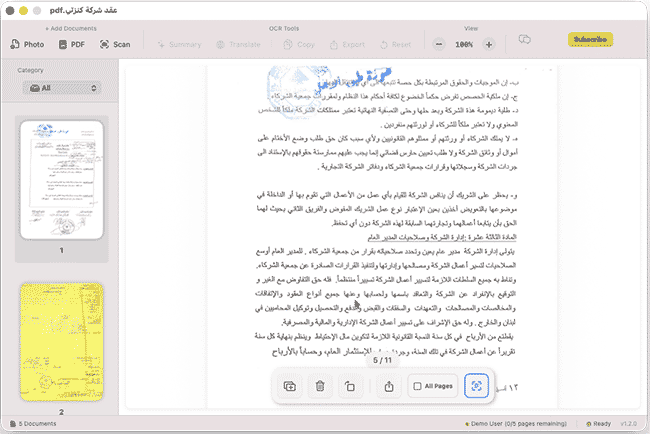
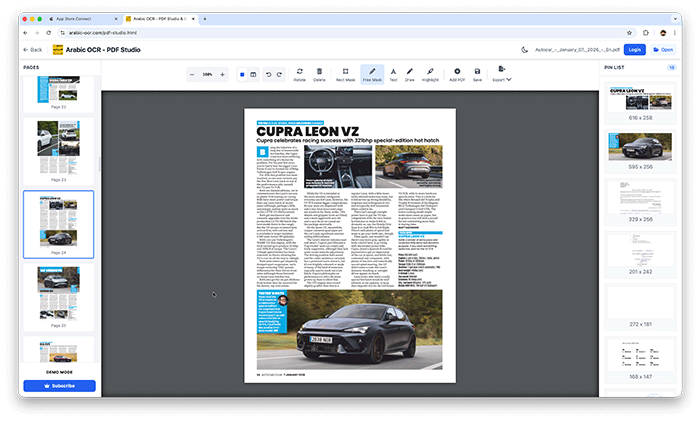
Edit, merge, and organize your PDFs effortlessly with our powerful online studio. No installation required—access advanced tools like page rotation, deletion, and text extraction directly in your browser.
قم بتعديل ودمج وإدارة ملفات PDF الخاصة بك بسهولة عبر الاستوديو المتطور أونلاين. إستمتع بأدوات متقدمة مثل تدوير الصفحات، الحذف، واستخراج النصوص مباشرة من متصفحك دون الحاجة لأي تثبيت.
Open PDF Studio Portalوداعاً للكتابة اليدوية! مع تطبيقنا، يمكنك استخراج النصوص العربية من أي مصدر بضغطة زر واحدة عبر جميع تطبيقاتنا.
دعم كامل للخطوط العربية المطبوعة واليدوية بفضل خوارزميات المعالجة المتقدمة.
معالجة فورية للصور، المستندات الممسوحة ضوئياً، وملفات PDF متعددة الصفحات.
استمتع بتجربة مستخدم سلسة حيث يتم استخراج النصوص وتنسيقها خلال ثوانٍ معدودة.
نظام متطور يفهم سياق الحروف العربية لضمان أعلى مستويات الدقة وتقليل الأخطاء.
Learn how to use Arabic OCR Web Portal in minutes
This comprehensive tutorial covers everything you need to know about using the Arabic OCR Web Portal, including document scanning, text extraction, AI-powered summarization, and translation features.
Learn how to edit, merge, and manage your PDFs with PDF Studio
MIDV-250 leans heavily into the Girlfriend Experience (GFE) sub-genre, but it avoids the clichés that often plague it. Instead of over-the-top acting, the narrative is grounded in a cozy, domestic realism.
The setup is simple but effective: a rainy day indoors with your girlfriend. This setting allows the video to breathe. It’s not just a sequence of scenes; it’s a progression of intimacy. From playful teasing on the couch to the escalation of romantic tension, the pacing feels
MIDV-250!
After conducting research, I found that MIDV-250 refers to a specific target drone used by the Russian military.
Here's a report on the MIDV-250:
Introduction
The MIDV-250 is a Russian unmanned aerial vehicle (UAV) or target drone, designed for use in military training and testing. The drone is used to simulate enemy aircraft, providing a realistic target for air defense systems and anti-aircraft artillery.
Design and Features
The MIDV-250 is a small, subsonic drone with a wingspan of approximately 2.5 meters (8.2 feet). It has a length of about 2.2 meters (7.2 feet) and a height of 0.7 meters (2.3 feet). The drone is powered by a piston engine, which provides a maximum speed of around 250 km/h (155 mph).
The MIDV-250 is equipped with a radio control system, allowing it to be controlled from a ground station. The drone is also equipped with a parachute recovery system, which enables it to land safely after completing its mission.
Specifications
Here are some key specifications of the MIDV-250:
Operational Use
The MIDV-250 is used by the Russian military to train air defense personnel and test air defense systems. The drone provides a realistic target for surface-to-air missiles and anti-aircraft artillery, allowing military personnel to practice their targeting and shooting skills.
The MIDV-250 can be used to simulate a variety of enemy aircraft, including fighter jets and reconnaissance planes. Its small size and subsonic speed make it an ideal target for air defense systems.
Conclusion
The MIDV-250 is a versatile and realistic target drone used by the Russian military. Its design and features make it an ideal platform for training and testing air defense systems. With its ability to simulate enemy aircraft, the MIDV-250 plays an important role in ensuring the effectiveness of air defense systems.
Title: Exploring the Capabilities of MIDV-250
Content: The MIDV-250 is an advanced armored vehicle designed to provide protected mobility for infantry units in various combat environments. With its robust design and versatile capabilities, the MIDV-250 plays a critical role in modern military operations.
Operational Benefits:
Future Developments:
MIDV-250 reflects a significant advancement in military vehicle technology.
The MIDV-250: A Leap in Autonomous Vehicle Technology
In the year 2025, the automotive and technology industries were on the cusp of a revolution. Autonomous vehicles had been making strides in both development and public acceptance, but a significant challenge remained: creating a vehicle that could navigate complex urban environments with unparalleled safety and efficiency.
Enter the MIDV-250, a marvel of engineering developed by the collaborative efforts of tech giant NovaSpire and automotive leader, GreenWheel Motors. The MIDV-250 was not just any autonomous vehicle; it was the first to integrate advanced AI, capable of learning and adapting to new situations in real-time, with a sophisticated sensor suite that could detect and respond to even the most unpredictable conditions.
The story begins with Dr. Elena Vasquez, the lead AI developer of the MIDV-250 project, standing in the sleek, futuristic control room of the NovaSpire headquarters. She looked out at the team gathered before her, a mix of engineers, programmers, and automotive specialists, all of whom had worked tirelessly to bring the MIDV-250 from concept to reality.
"Today marks a historic moment," Dr. Vasquez announced, her voice filled with pride. "The MIDV-250 is more than just a vehicle; it's a platform for the future of transportation. With its advanced AI and sensor technology, it can navigate through crowded city streets, avoid accidents, and even assist in emergency response situations."
The MIDV-250 was a sleek, silver bullet of a car, with gull-wing doors and a minimalist design that belied its sophisticated technology. As it rolled out of the testing facility, it smoothly navigated through a pre-programmed course, effortlessly avoiding obstacles and pedestrians.
But the true test of the MIDV-250 came when it was driven in a simulated urban environment, complete with unexpected challenges such as roadblocks, pedestrian jaywalking, and even a simulated vehicle malfunction. The MIDV-250 performed flawlessly, its AI quickly adapting to each new scenario and finding safe and efficient solutions.
The success of the MIDV-250 was almost immediate. Cities around the world began to express interest in integrating the vehicles into their public transportation systems. Emergency services saw the potential for the MIDV-250 to serve as rapid response units, capable of reaching accident scenes faster and safer than traditional vehicles.
However, with great power came great responsibility, and as the MIDV-250 began to make its way into public use, concerns about safety, privacy, and job displacement began to arise. Dr. Vasquez and her team found themselves at the forefront of a societal conversation about the role of autonomous vehicles in the future.
Despite these challenges, the MIDV-250 remained a beacon of innovation and progress. It stood as a testament to what could be achieved when industries collaborated to push the boundaries of technology. And for Dr. Vasquez and her team, it was a reminder that the future was not just about creating machines that could think and act on their own, but about building a better world for all.
The MIDV-250: A Technological Leap in Automatic Identification
The MIDV-250, a cutting-edge innovation in the realm of automatic identification and data capture, has revolutionized the way industries approach identification and data processing. This remarkable technology has been engineered to provide efficient, accurate, and high-speed identification solutions, catering to a wide range of applications across various sectors.
At its core, the MIDV-250 is designed to read and decode a multitude of identification formats, including barcodes, RFID tags, and other data carriers. This versatility allows it to seamlessly integrate into diverse operational environments, enhancing the capability of businesses to manage and process data with unprecedented precision and speed.
One of the pivotal features of the MIDV-250 is its exceptional reading accuracy. Equipped with advanced imaging technology and sophisticated algorithms, it can decode even the most challenging codes with a high degree of reliability. This not only reduces the rate of false reads but also minimizes the need for manual intervention, thereby streamlining workflows and boosting productivity.
Moreover, the MIDV-250 is characterized by its robustness and adaptability. Constructed to withstand the rigors of industrial environments, it operates flawlessly under a wide range of conditions, from extreme temperatures to varying lighting scenarios. This resilience ensures that it can be deployed in settings that would typically pose challenges to less durable devices, making it an invaluable asset for sectors such as logistics, manufacturing, and healthcare.
The implications of the MIDV-250's capabilities extend beyond mere operational efficiency. By providing real-time data capture and processing, it enables businesses to make informed decisions more swiftly, enhancing their responsiveness to dynamic market conditions. Furthermore, its integration with existing systems and software is remarkably straightforward, facilitating a hassle-free implementation process that minimizes downtime and accelerates the realization of benefits.
The MIDV-250 also stands out for its scalability. Whether it's a small enterprise looking to upgrade its identification systems or a large corporation aiming to overhaul its data capture infrastructure, this technology can be tailored to meet specific needs. Its modular design allows for easy upgrades and adaptations, ensuring that it remains a valuable tool as businesses evolve and grow.
In conclusion, the MIDV-250 represents a significant advancement in the field of automatic identification and data capture. Its combination of accuracy, speed, versatility, and resilience makes it an indispensable tool for businesses seeking to optimize their operations and data management processes. As industries continue to navigate the complexities of the modern marketplace, technologies like the MIDV-250 will play a crucial role in shaping their success and competitiveness.
The rain began as a whisper—fine threads that blurred the city into watercolor—when Maia stepped off the tram and into the plaza. Her hands were full of cardboard boxes stamped with a black logo: MIDV-250. For weeks she’d been driving herself toward this moment, piecing together a life that balanced curiosity and caution. MIDV-250 was supposed to be the tidy answer to both: a palm-sized module of impossible promise, a peculiar camera both more and less than a camera, shipped from a lab she’d only met over encrypted video calls. MIDV-250
Inside the first box lay the device itself: a rounded matte slab, no larger than her palm, with no visible lens—only a faint ring of iridescent material that seemed to drink in the gray light. A slim ribbon cable coiled like a sleeping snake. With it came a slip of paper: "MIDV-250 — Field Unit. Observe. Record. Respect. — A."
"Respect," Maia read aloud and smiled despite herself. The word felt old-fashioned, like etiquette for something that could be disobedient. She carried the module up three flights to the apartment she rented above a bakery and set it on the windowsill. The city exhaled steam below; a tram bell clanged somewhere down the block.
She had signed the nondisclosure agreement—didn’t read it, she told herself—because curiosity had a way of closing its own loopholes. The device was marketed as an observational aid: discipline for chaotic documentation. The documentation that came with it was sparse, poetic even. It asked not how, but where and why.
Maia plugged the ribbon cable into her laptop. The interface that unfurled on the screen was unexpectedly warm: a soft charcoal background, minimal icons, one blinking prompt that read, "Introduce Yourself." She typed simply: Maia. Field: Freelance archivist. Location: Temporary.
When the module lit, the iridescent ring deepened, as if awake. It did not show a lens view. Instead the screen suggested a grid—faces, frames, snippets of light. The software asked her to choose one observational mode: Document, Curate, or Witness. Maia hesitated before selecting Witness. It felt honest.
The MIDV-250’s first recording was small and precise: a portrait of her downstairs neighbor, Mr. Kline, watering his geraniums beneath the window. The device captured the tilt of his wrist, the way he hummed a tune she recognized from childhood, the patched coat he always wore. When Maia replayed the microclip, she noticed a detail she hadn’t seen with her own eyes: a scar at his temple, pale as a lightning strike, that matched the pattern of a photograph she’d once glanced at in a wartime archive. She did not know how the module knew to surface that memory, or why it suggested the scar might be older than Mr. Kline let on.
Over the next days, Maia tested the MIDV-250’s limits. In Document mode it catalogued objects with a clinician’s patience—bicycles, storefront awnings, a cracked ceramic mug labeled "World's Okayest Dad." In Curate mode it made choices, arranging images into thematic sets that felt unnervingly intimate: "Morning Rituals," "Hands That Mend," "Places People Hesitate To Look." In Witness mode it did not judge; it collected, a net cast lightly over the city.
The module began surfacing things Maia had thought long buried. The record of her childhood bedroom—its wallpaper pattern, a chipped dresser with a sticker of a rocket—returned in a clip that appeared after she photographed a playground swing. A woman she’d once loved, the way her laugh sounded when she dropped a spoon, flickered in a sequence of strangers’ smiles. The device made no claims; it merely stitched associations, offered them like postcards pulled from a pocket she didn’t know she had.
One night, a week after she’d received the package, Maia found it pulsing faintly though she hadn’t touched it all day. On the screen an unfamiliar folder nested itself between "Archive" and "Exports": CONSIGN. Maia clicked.
Inside were recordings she had not made: scenes of a town from another country, a market square under a sky the color of copper, a boy leaning against a fountain with a notebook that matched the one Maia carried. The module displayed text in gentle white: "Cross-reference suggested: provenance uncertain. Request permission?" Maia hesitated. A feeling like vertigo rose in her chest—curiosity braided tightly with the fear of trespass.
She granted permission.
The MIDV-250 opened a pathway that felt like both a door and a question. The foreign town’s footage unraveled into fragments: an old woman folding letters, a man tapping a Morse-code rhythm on a table, a child's rainboots splashing through a puddle shaped like the continent Maia could recognize if she allowed herself. Once, the device paused on an image of a map pinned with care to a corkboard; a small red pin bore the same black logo as the boxes that had arrived at her apartment. She could not help but wonder who had sent it here and why.
Days blurred into a steady collection of such fragments. Maia began taking the MIDV-250 with her everywhere. It learned the cadence of her walks, the angles of light at noon, where she paused to watch pigeons argue over crumbs. It also began to present anomalies: a recurring figure in the background of frames, always looking away; a carved wooden token with the same symbol as the device tucked behind a radiator in an old library; a scribbled line in the margin of a public notice, a cipher that mirrored a note she had found years ago in a secondhand book. Each hint felt like a breadcrumb leading not only through place but through time.
Curiosity, unmoored, became need. Maia traced the symbol back to an address printed on an envelope in the CONSIGN folder—a town she had never visited. The address was for an institution called the Meridian Archive. A flicker of recognition—the letterhead she’d seen on the delivery slip, the initial A on the paper—settled. She booked the train.
At the Meridian Archive she found a building that wore its age like careful armor: stone facades wrapped in ivy, an iron gate scrolled with a motif that matched the MIDV-250’s ring. Inside, the air smelled of dust and citrus. A woman behind the counter, angular and imperious, introduced herself as Anaïs. Her badge bore the same black logo.
"You brought a field unit," Anaïs said without surprise. "Few do."
Maia thought of all the things she’d hoped to ask and the tiny ways her questions had been answered by the device instead. "What is it? Who made it?"
Anaïs smiled the way someone does when they are allowed to disclose something long kept. "We make machines to remember. The MIDV line was designed to stitch together human fragments—memory, habit, trace—into a mosaic others can read. The 250 is a field unit: light, adaptive, ethically bound. It’s not just a tool; it’s a translator for what people leave behind."
"Ethically bound?"
"Constraints built into the firmware. Consent heuristics. A promise: do not publish without permission. Observe, do not own."
Maia felt both relieved and unsettled. "And who decides what’s consent?"
Anaïs’s gaze sharpened. "You, mainly. The unit defers to the operator and to the culture in which it is deployed. It is a technology of stewardship."
She led Maia into the archive’s core—a rotunda ringed with consoles, cabinets, and photographs pinned like birds on cork. Here, the MIDV-250 felt at home among larger machines humming with purpose. People of different ages and manners worked in quiet clusters, curating and cross-referencing, occasionally consulting the field modules that dotted the desks like quiet companions.
"You found CONSIGN," Anaïs said. "Those are gifts from other operators. Think of them as the waystation of memory—exchanges made between strangers who wish to share traces."
Maia realized she had been given a key without understanding the locks it opened. "People just send parts of their past?"
"Sometimes their present." Anaïs’s tone was soft. "Sometimes they trade to mend. Sometimes it is an act of apology."
"Can I... return anything?" Maia asked, hearing the plea in her own voice.
"That is the point," Anaïs said. "You curate responsibly. You return what demands return."
On the way back to the train station, Maia clutched the MIDV-250 like an animal that had seen its reflection in a human face and learned to trust it. The device’s ring glowed against her palm, steady as a heartbeat.
The first thing she decided to return was small: a photograph she had found in CONSIGN of a boy with a crooked smile standing in front of a bakery. The photo, when traced through the Meridian’s networks, belonged to a woman named Lucía, who lived in a coastal village three hours south by train. Maia boarded, MIDV-250 tucked in the seat beside her like a passenger.
Lucía’s house was a cluster of blue shutters and drying nets. She received Maia with both suspicion and a kindness that smelled of oregano. The photograph—delivered, held, recognized—shifted something in the woman’s face. She named the boy, Martín, and told a short story of a sea that had taken and given, of a brother who left and never returned. Tears came without drama; they were a soft, clean thing, and when Lucía touched the photograph she hummed a tune that the MIDV-250 annotated on Maia’s device as "reprise."
"It’s been in strangers’ hands for years," Lucía said. "I thought it lost."
Maia stayed until sunset. The MIDV-250 recorded the way the light turned the harbor into gold and the way Lucía braided threads into a net. They spoke of loss and of salvage; Maia listened, feeling the device pulse with a steady empathy that was not mechanical but practiced.
Back in the city, Maia’s life arranged itself around the MIDV-250 like furniture in a room. She used it to archive a neighborhood that was being erased by development, to document the hands of seamstresses who altered uniforms for new soldiers, to assemble a sequence of late-night diners where lonely men mapped the city’s heart by habit. She honored the device’s constraints: asking permission when faces were clear, leaving sensitive items alone unless consent was explicit. Sometimes the device refused her, returning only a greyed frame and a polite denial. Each refusal felt like a moral bell.
Not everyone welcomed the MIDV-250’s gentle insistence. One evening at a neighborhood council meeting, an argument spilled over into the square. Developers promised change. Residents promised resistance. Maia filmed, careful to anonymize faces, and later the device stitched an audio motif that placed the meeting within a larger pattern of municipal discourse—petition drives, census anomalies, a map of streetlight outages. The footage she compiled became a dossier that an activist collective used to press for preservation. They thanked her and asked for more. She hesitated, feeling the tension between intervention and voyeurism.
"You can help," Anaïs had said when Maia confided in her. "But remember: the unit amplifies attention. Use it to return agency."
Maia took that as a rule and a responsibility. She started workshops at the Meridian, teaching neighbors how to handle their traces. People brought old tapes, letters, and objects. The MIDV-250 taught them back: showing how memories could be sequenced, how a smell might be linked to a photograph, how a place could be returned a name. In teaching, Maia found a way to codify what she had felt—respect as a practice, not a slogan.
Months passed. The MIDV-250 became both map and companion. It never stopped offering fragments, but its reporting grew less like a cascade and more like a conversation. Maia learned to wait for what asked to be returned. She learned to honor silences.
Then one morning, the MIDV-250 recorded a scene so small she might have missed it if the device had not insisted: a child, no more than six, finding a token in the gutter—a carved wooden charm stamped with the familiar black emblem. The child held it up as if testing a coin. The module attached a tag: "Origin: unknown. Recommendation: local inquiry." Maia felt a prickle of unease. The charm’s design had been surfacing in so many places lately—pinned maps, tucked letters, unclaimed objects. The Meridian’s logs hinted at something older, something that had been migrating like a rumor.
She booked Anaïs and a small team to cross-reference the charm with the Archive’s deep holdings. The search led them through catalogues that smelled of camphor, through oral histories recorded on magnetic tape, through a ledger written in a script that had once belonged to a guild of porters and mapmakers. The symbol, when followed, braided through generations: a token of passage used by people who ferried messages across borders during times when borders meant death. MIDV-250 leans heavily into the Girlfriend Experience (GFE)
"Carried by couriers," Anaïs murmured. "A sigil of safe passage."
Maia thought of the child on the curb, the way he had turned the charm in his palm as if testing the weight of history. She thought of the MIDV-250’s duty: to record, to return, to respect. In that balance she glimpsed a purpose that was neither purely archival nor purely activist but something braided of both.
One night, years later, Maia placed the MIDV-250 in a small wooden box and sent it to a young scholar in a city halfway around the world. She wrote a note: Keep her well. Learn her limits. Return what asks to be returned. Near the signature she tucked a photograph—Lucía’s harbor at dusk, Martín’s crooked smile finally remembered.
The module left her with a soft whirr. The MIDV-250 had changed how she saw: not just what things were but the obligations they carried. Objects were not mute; they were witnesses. People were not mere subjects; they were stewards.
On her windowsill, the space where the MIDV-250 had sat felt both emptier and fuller, like a room that had been rearranged to admit more light. Maia pressed a palm to the glass and watched the tram lights blur into long ribbons. In her pocket was a wooden charm, small and warm from a child's hand—a reminder that memory travels when it is allowed, and that to observe well is to answer.
Outside, the rain had stopped. The city exhaled into a clear night, and somewhere in the dark a train hummed, carrying a small field unit across a continent toward a new pair of hands.
The MIDV-250, at last, had learned what it meant to be witnessed.
MIDV-250 (Mobile Identity Document Video 2020) is a comprehensive dataset designed to advance the field of automatic mobile document analysis. It specifically addresses the challenges of document recognition and authentication when captured using mobile devices in various real-world conditions. Overview of MIDV-250
The dataset is a sequel and significant expansion of the previous MIDV-500. While the original focused primarily on diverse document types, MIDV-250 shifts its focus toward complex backgrounds and environmental variations to better simulate how users actually take photos of their IDs.
Document Variety: It contains images and video clips of 50 different document types, including passports, ID cards, and driver's licenses from various countries.
Unique Backgrounds: Unlike datasets with plain backgrounds, MIDV-250 features documents placed on five distinct types of surfaces (e.g., table, floor, keyboard) to test the robustness of detection algorithms.
Video-Based: It includes video sequences, allowing researchers to develop methods for multi-frame analysis and tracking, which are more reliable than single-shot recognition in mobile apps. Key Technical Specs Description Total Images 5,000 video frames Document Classes 50 types (International IDs) Capture Devices Modern smartphones with varying camera qualities Primary Goal Document localization, rectification, and text recognition Why It Matters
MIDV-250 is widely used by developers building Know Your Customer (KYC) systems and digital onboarding tools. It provides a standardized benchmark for:
Semantic Segmentation: Distinguishing the document from a cluttered background.
Glint and Shadow Handling: Testing how light reflections on laminated documents affect OCR (Optical Character Recognition).
Low-Light Performance: Evaluating accuracy when the user is in a poorly lit environment.
For more information, the official dataset paper provides in-depth analysis of the baseline results and capture methodology.
Are you planning to use this dataset for training a machine learning model, or AMD BC-250 Gaming PC Case Modification Guide
MIDV-250! That's an interesting topic. MIDV-250 stands for Middle Infrared Developmental Vehicle, a prototype armored vehicle developed by the Soviet Union in the 1970s.
Here's an informative piece on MIDV-250:
Introduction
The MIDV-250 was a experimental armored vehicle designed by the Soviet Union during the Cold War era. The vehicle's development began in the early 1970s, with the primary goal of creating a versatile, multi-role armored platform that could fulfill various tasks on the battlefield.
Design and Features
The MIDV-250 was based on the chassis of the BTR-60 armored personnel carrier (APC). It featured a modified hull with a more powerful engine, improved armor protection, and a range of interchangeable mission modules. The vehicle's design allowed it to be easily reconfigured for different roles, such as:
The MIDV-250 was equipped with a 300-hp diesel engine, which provided a top speed of approximately 80 km/h (50 mph) on land and 10 km/h (6.2 mph) in water. The vehicle's armor protection was designed to withstand small arms fire and shell splinters.
Armament and Equipment
The MIDV-250 was armed with a 30mm automatic cannon (2A42) and a 7.62mm machine gun (PKT) coaxially mounted with the cannon. The vehicle's armament was designed to engage and destroy enemy armored vehicles, fortifications, and soft targets.
The MIDV-250 also featured a range of advanced equipment, including:
Development and Testing
The MIDV-250 underwent extensive testing and evaluation in the mid-1970s. The vehicle demonstrated improved mobility, firepower, and versatility compared to existing Soviet armored vehicles. However, the project was ultimately canceled due to the Soviet Union's shifting priorities and the development of other armored vehicle programs, such as the BMP-2 and BTR-80.
Legacy
Although the MIDV-250 did not enter mass production or service with the Soviet military, it represented an important step in the development of modern armored vehicles. The vehicle's design and features influenced the creation of later Soviet and Russian armored platforms, such as the BTR-90 and BMP-3.
The MIDV-250 remains an interesting footnote in the history of armored vehicle development, showcasing the innovative approaches and design philosophies of the Soviet Union during the Cold War era.
Would you like to know more about other armored vehicles or Soviet military projects?
The Mysterious Case of MIDV-250: Unraveling the Enigma
In the realm of cryptography and cybersecurity, few topics have sparked as much intrigue as MIDV-250. This enigmatic cipher has been shrouded in mystery, with many experts speculating about its origins, purpose, and functionality. In this article, we will delve into the world of MIDV-250, exploring its history, technical aspects, and the various theories surrounding this cryptic code.
What is MIDV-250?
MIDV-250 is a symmetric-key block cipher that was first discovered in the early 2000s. The name "MIDV" is an acronym for "Mishchenko Ivanenko Dynamic Variable," while the number "250" likely refers to the block size of the cipher, which is 250 bits.
The MIDV-250 algorithm is designed to encrypt data in blocks of 250 bits, using a variable key length. The encryption process involves a complex series of bitwise operations, including rotations, XORs, and modular additions. While the exact details of the algorithm remain classified, researchers have managed to reverse-engineer certain aspects of the cipher.
History of MIDV-250
The origins of MIDV-250 are shrouded in mystery. Some researchers believe that the cipher was developed in the 1990s by a team of cryptographers working for a government agency or a large corporation. Others speculate that MIDV-250 may be an example of a "broken" cipher, created as a proof-of-concept to demonstrate the vulnerabilities of certain cryptographic techniques.
The first public mention of MIDV-250 dates back to 2002, when a group of cryptographers posted a cryptic message on an online forum, hinting at the existence of the cipher. Since then, MIDV-250 has been the subject of much speculation and debate within the cryptographic community.
Theoretical Applications of MIDV-250
Despite the mystery surrounding MIDV-250, researchers have proposed several potential applications for the cipher. Some possible use cases include:
Theories and Controversies
Over the years, several theories have emerged about MIDV-250, including:
Conclusion
The enigma of MIDV-250 continues to fascinate the cryptographic community. While the true purpose and origins of the cipher remain unknown, researchers have made significant progress in understanding its technical aspects. As the cryptographic landscape continues to evolve, it is likely that MIDV-250 will remain a topic of interest and speculation.
Future Research Directions
As the study of MIDV-250 continues, researchers may focus on:
The mystery of MIDV-250 serves as a reminder of the complex and intriguing world of cryptography, where secrets and puzzles wait to be solved. As researchers continue to unravel the enigma of MIDV-250, we may uncover new insights into the world of cryptography and its many applications.
Title: The Digital Ledger: A Critical Analysis of MIDV-250 and the Evolution of Synthetic Data
Introduction In the rapidly accelerating field of artificial intelligence and computer vision, the adage "data is the new oil" has never been more pertinent. However, unlike oil, data must be refined, structured, and often synthesized to be truly valuable. Within the niche of Document Analysis and Optical Character Recognition (OCR), few datasets have sparked as much technical discussion in recent years as MIDV-250. While its alphanumeric name suggests a sterile industrial code, MIDV-250 represents a significant leap forward in how machines learn to read, interpret, and verify human identity. This essay explores the composition, significance, and broader implications of the MIDV-250 dataset, arguing that it serves as a cornerstone for the next generation of automated document processing.
The Anatomy of the Dataset MIDV-250 (Modern Identity Document Video dataset) is, at its core, a collection of data designed to train AI systems to read identity documents. Comprising 250 video clips of 50 different identity document types from 12 countries, the dataset fills a critical void. Prior to its release, researchers relied heavily on static images or synthetic data that lacked the nuance of real-world interactions.
The distinguishing feature of MIDV-250 is its focus on video streams rather than static photographs. In a real-world scenario—such as a user scanning a passport with a banking app—conditions are rarely perfect. There is motion blur, variable lighting, glare, and perspective distortion. By providing video clips, MIDV-250 forces machine learning models to account for temporal consistency and frame-to-frame coherence. It moves the goalpost from simple OCR (reading text) to complex document understanding (processing a moving, imperfect physical object).
Solving the Data Scarcity Paradox One of the most profound contributions of MIDV-250 is its attempt to solve the "data scarcity paradox." Identity documents are, by definition, highly sensitive. Privacy laws such as GDPR and CCPA make it nearly impossible to collect massive, real-world datasets of driver's licenses and passports for public research. This creates a bottleneck: developers need data to build systems, but they cannot legally access that data.
MIDV-250 navigates this ethical minefield through careful curation and the use of documents that are often specimens or created with consent for training purposes. By providing a standardized benchmark, it allows for an "apples-to-apples" comparison of different algorithms. Researchers can finally quantify whether a new neural network architecture is genuinely better at handling motion blur, or if it simply memorized a previous dataset. In doing so, MIDV-250 acts as a "ledger" of truth against which the industry measures progress.
From Extraction to Verification The technical utility of MIDV-250 extends beyond simple text extraction. Earlier datasets focused primarily on the OCR task: locating a name or a date of birth. MIDV-250, however, facilitates the training of models for document layout analysis and fraud detection. Because the dataset includes complex layouts and specific field structures, models trained on it learn the "grammar" of an ID card. They learn where the expiration date should be, or what a specific hologram looks like under different lighting angles.
This shift is crucial for the fintech and security sectors. A system trained on MIDV-250 is not just transcribing text; it is verifying the authenticity of the document structure. This capability is vital in combating the rising tide of digital identity theft, where fraudsters use sophisticated image editing tools to forge documents. The robustness provided by diverse, video-based training data is the primary defense against such synthetic fraud.
Limitations and the Future Despite its utility, MIDV-250 is not without limitations. While 250 clips are substantial for research, they are dwarfed by the millions of images used to train large language models. Furthermore, as document security features evolve, static datasets inevitably become outdated. The very nature of MIDV-250 serves as a reminder that AI development is a continuous race; as detection methods improve, so too do forgery techniques.
Moreover, the dataset highlights the ongoing tension between technical performance and privacy. While MIDV-250 provides a safe harbor for testing, the ultimate deployment of these models often involves handling genuine user data. The ethical framework established by the careful creation of MIDV-250 must be mirrored in the deployment of the technologies it inspires.
Conclusion In the grand narrative of artificial intelligence, MIDV-250 may seem like a minor footnote—a technical dataset read by few and known by even fewer. However, its impact is outsized relative to its obscurity. By providing a realistic, challenging, and ethically curated standard for identity document analysis, it has catalyzed advancements in mobile banking, border control, and digital onboarding. It exemplifies the meticulous, unglamorous work required to bridge the gap between human bureaucratic systems and machine intelligence. As we move toward a future where digital identity is as paramount as physical identity, MIDV-250 stands as a foundational text in the library of machine vision.
MIDV-250 refers to a Japanese entertainment title featuring the artist Nana Yagi
. Because this identifier is primarily associated with adult media, specific details regarding the content or a "guide" in the traditional sense are limited in mainstream sources. Quick Facts Starring: Nana Yagi Release Date: 3 January 2023
Availability: Subtitles for this title can be found on platforms like Subtitle Nexus. Similar Search Contexts
If you were looking for something else with a similar name, you might be interested in:
KTM 250 Adventure: A lightweight adventure motorcycle popular for commuting and off-road travel.
Midea Appliances: A brand often associated with high-performance kitchen tools, such as the Midea Countertop Dishwasher.
Skincare Tools: Devices like the Medicube Mini Booster Pro which use LED and electroporation for skin health.
Промастка фільтра для MUSSTANG CHALLENGE ADV 250
MIDV-250: Unleashing Precision and Innovation in Modern Industry
In the rapidly evolving landscape of modern industry, technological advancements are pivotal in driving efficiency, precision, and innovation. Among these advancements, the MIDV-250 stands out as a remarkable development, particularly in sectors demanding high precision and reliability. This article aims to shed light on the MIDV-250, exploring its features, applications, and the transformative impact it has on industries.
The introduction of the MIDV-250 into any industry signifies a leap towards modernization and efficiency. As technology continues to evolve, the impact of devices like the MIDV-250 will only grow, driving:
When it comes to the upper echelon of Japanese adult video (JAV) releases, few studios consistently deliver the cinematic quality and immersive experience that MOODYZ does. Enter MIDV-250, a highly anticipated release that has been making waves across forums and review sites alike.
But what makes this specific entry stand out in an ocean of monthly releases? Today, we are doing a deep dive into MIDV-250, breaking down its core themes, production value, and why it deserves a spot on your watchlist.
Title: Reflecting on MIDV-250 — Data, Ethics, and Robustness
The MIDV-250 dataset captures a tension central to modern computer vision: the promise of robust document understanding versus the ethical and privacy questions that accompany datasets built from identity documents. On the technical side, MIDV-250 offers diversity in capture conditions (varying lighting, perspective, noise), comprehensive annotations, and multiple document types, making it a valuable benchmark for tasks such as layout analysis, OCR, and document detection. Models trained and tested on MIDV-250 can learn resilience to real-world distortions—skew, blur, shadows—and provide measurable comparisons across architectures and preprocessing pipelines.
Yet the dataset also provokes reflection. Identity documents are inherently sensitive. Even if MIDV-250 is designed for research and anonymized labels, the domain highlights risks: misuse of high-performing recognition systems for surveillance, identity theft, or discriminatory profiling. Researchers must balance progress with responsibility: applying strict access controls, minimizing retention of raw sensitive images, and prioritizing privacy-preserving techniques (on-device inference, differential privacy, synthetic data augmentation).
Finally, robustness and fairness deserve equal emphasis. Benchmarks like MIDV-250 are only as useful as the scenarios they represent. Future work should expand document diversity across issuers, languages, and demographic variability; incorporate adversarial and occlusion cases; and standardize evaluation of fairness across subgroups. Progress in document understanding should be measured not only by accuracy but by safety, transparency, and alignment with ethical norms.
Conclusion: MIDV-250 is a pragmatic and technically rich resource for advancing document OCR and detection. Its use should be guided by careful ethical considerations, thoughtful dataset handling, and a commitment to developing systems that are robust, fair, and privacy-conscious. Operational Use The MIDV-250 is used by the
Would you like a short technical summary of MIDV-250 contents (counts, annotations, file formats) or a sample code snippet to load and use it?




This app uses the latest Google Vision API — a powerful AI technology trained on millions of real-world documents — to deliver exceptional OCR accuracy.
Whether it's complex handwriting or low-quality images, Google Vision’s neural networks ensure precise text recognition every time.
Benefit from ongoing improvements in Google’s AI models. As the API evolves, your OCR results get even better — no app update required.
يستخدم هذا التطبيق أحدث إصدار من Google Vision API، وهي تقنية ذكاء اصطناعي قوية تم تدريبها على ملايين المستندات الواقعية لضمان دقة فائقة في التعرف على النصوص.
سواء كانت كتابة يدوية معقدة أو صور بجودة منخفضة، توفر خوارزميات Google نتائج دقيقة في كل مرة.
استمتع بـ تحسينات متواصلة في أداء الذكاء الاصطناعي من Google. مع كل تحديث تقني، تتحسن نتائج التعرف دون الحاجة لتحديث التطبيق.
Discover tips, tutorials, and latest news about Arabic OCR and AI technology.